Kinematic Knee Replacement

A knee replacement planned around your natural alignment.

Kinematic knee replacement is a patient-specific alignment philosophy for total knee replacement. Instead of forcing every knee toward one standard mechanical axis, the plan aims to restore the patient's native knee geometry when it can be done safely.

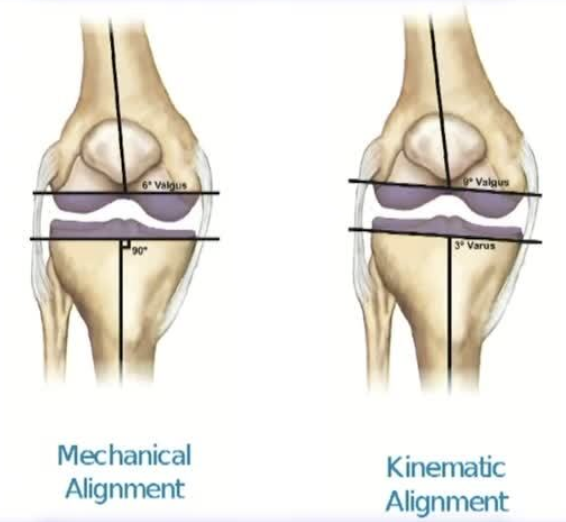
Mechanical alignment and kinematic alignment knee replacement comparison diagram
Direct Answer

What is kinematic knee replacement?

Kinematic knee replacement is a way of planning and aligning a total knee replacement around the patient's own knee anatomy. The surgeon still replaces the damaged joint surfaces, but the alignment goal is more individualized than traditional mechanical alignment.

The concept is often described as "restore, not replace": restore the knee's natural joint-line orientation and ligament balance where appropriate, rather than making every patient's knee match the same neutral template.

Important: kinematic alignment is not right for every knee. Severe deformity, instability, bone loss, revision surgery, and other factors may require a different plan.
Why It Matters

Mechanical alignment vs. kinematic alignment

01

Traditional target

Mechanical alignment generally aims to place the knee components around a neutral limb axis. This has a long track record and remains appropriate for many patients.

02

Patient-specific target

Kinematic alignment aims to recreate the patient's pre-arthritis knee orientation and soft-tissue balance when the surgeon believes that target is safe.

03

Evidence is evolving

Research suggests potential advantages in knee feel and early function for some patients, but the decision still depends on careful surgical judgment.

Care Pathway

What the surgeon is trying to balance

1

Bone geometry

X-rays and planning show how arthritis has changed the joint line and limb alignment.

2

Ligament tension

The knee should feel stable without being over-tightened or made unnaturally loose.

3

Implant position

The surgeon chooses component position to support stability, motion, and implant performance.

4

Recovery goals

The plan supports walking, range of motion, pain control, and safe discharge planning.

Patient Questions

Common questions

Does kinematic alignment mean custom implants?

Not necessarily. It refers to the alignment and balancing philosophy. Implant choice, robotic assistance, and patient-specific tools are separate decisions.

Will it feel more natural?

That is the goal, and some studies report improved patient-reported outcomes. No technique can guarantee a natural-feeling knee for every patient.

Is it experimental?

It is an established and actively studied alignment strategy, but evidence and surgeon adoption continue to evolve. Patient selection matters.

Who should consider it?

Patients with knee arthritis considering replacement should ask whether their anatomy is appropriate for a patient-specific alignment plan.

Sources

Patient education and claim-control references used for this page: AAOS Total Knee Replacement, AAHKS Total Knee Replacement, and peer-reviewed review/meta-analysis on patient-reported outcomes after kinematic vs. mechanical alignment.

Next Step

Ask whether your knee can be restored around your own anatomy.

A TJS knee replacement specialist can review your imaging, symptoms, and activity goals and explain whether kinematic alignment belongs in your plan.

Schedule Appointment